

RFID Returnable Container Tracking helps manufacturers improve the visibility of reusable assets, reduce container losses, and optimize supply chain operations. The Cummins RFID implementation demonstrates how combining RFID hardware with cloud-based software can create a scalable solution for managing returnable packaging across complex supply networks.
In modern manufacturing, returnable containers are essential assets that support the movement of components between suppliers, logistics providers, and production facilities. These reusable containers, including plastic totes, bins, and industrial packaging, help companies reduce waste while maintaining efficient material flow.
However, as supply chains become more complex, managing thousands of returnable containers across multiple locations becomes increasingly difficult. Companies need to know where each container is located, who is responsible for it, and whether it is returned within the expected timeframe.
Without accurate tracking, manufacturers may experience container shortages, unnecessary replacement costs, and inefficient inventory management.
Cummins, a global manufacturer of engines and power solutions, faced similar challenges in managing reusable packaging across its supply chain. By implementing an RFID-enabled returnable packaging solution, Cummins created better visibility into container movement and improved the management of its reusable assets.
This real-world case shows how RFID Returnable Container Tracking can transform traditional container management into a more automated, data-driven process.
Cummins’ Challenge: Managing Returnable Packaging at Scale
Cummins operates a global manufacturing network producing engines, power systems, and related technologies. As part of its sustainability strategy, the company aimed to reduce packaging waste generated during manufacturing operations.
These materials included disposable packaging such as:
- Corrugated cardboard;
- Disposable plastics;
- Other single-use transportation materials.
To address this challenge, Cummins launched a returnable packaging initiative focused on replacing disposable packaging with Returnable Transport Items (RTIs).
Returnable containers provide significant environmental and operational benefits because they can be reused repeatedly throughout the supply chain. However, increasing the use of reusable packaging introduced another challenge:
How can a company effectively track hundreds of thousands of containers moving between suppliers, factories, and logistics locations?
A successful returnable packaging program requires visibility into the entire asset lifecycle.
Companies need to know:
- Where each container is currently located;
- Which supplier or facility has custody of the container;
- How long containers remain at each location;
- Whether containers are returned and ready for reuse.
This requirement led Cummins to explore an RFID-based tracking solution.
Why Cummins Selected RFID for Returnable Container Tracking
Before implementing RFID technology, Cummins considered traditional tracking methods, including manual tracking and barcode-based identification.
However, these approaches created several limitations.
Manual Tracking Challenges
Manual tracking often requires employees to record container movements by hand or update spreadsheets.
For large-scale supply chains, this creates problems such as:
- Time-consuming data entry;
- Delayed information updates;
- Higher risk of human errors;
- Limited real-time visibility.
Barcode Tracking Limitations
Barcode systems can improve identification compared with manual records, but they still require employees to scan containers individually.
For a supply chain involving thousands of reusable containers, manual barcode scanning can reduce operational efficiency.
RFID offered a more automated approach.
Unlike barcode scanning, RFID technology can identify multiple tagged assets automatically when they pass through a reading area.
This allows companies to collect movement data with less human involvement and improve tracking accuracy.
During testing, Cummins found that the RFID solution could operate effectively even in industrial environments with metal racks and equipment. The system achieved approximately 99% read accuracy.
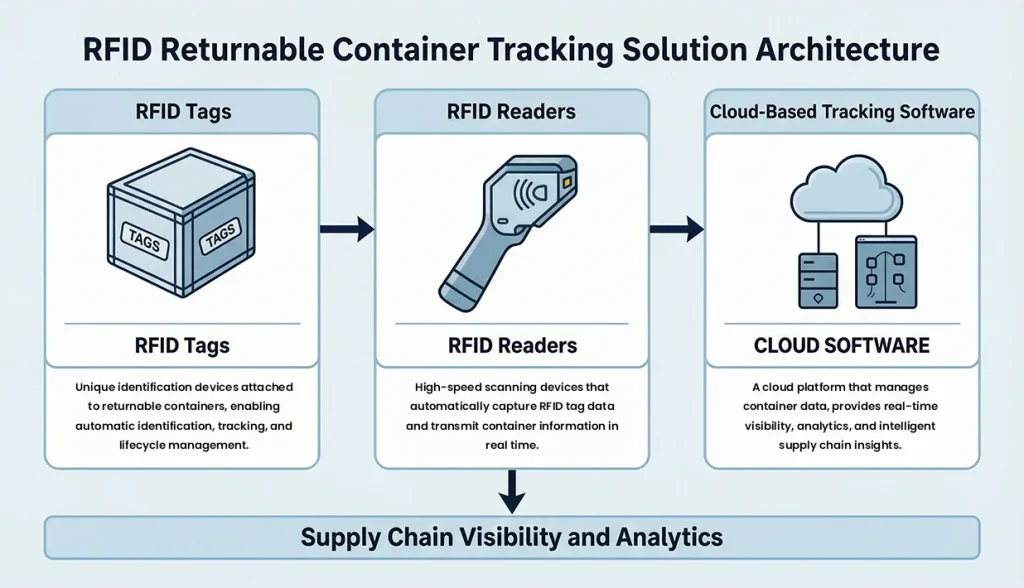
Cummins RFID Returnable Container Tracking Solution Architecture
Cummins’ RFID solution combines three key elements:
RFID Tags
↓
RFID Readers
↓
Cloud-Based Tracking Software
↓
Supply Chain Visibility and Analytics
Together, these components create a complete RFID Returnable Container Tracking system.
RFID Tags Create a Digital Identity for Every Container
The foundation of the system is assigning each reusable container a unique digital identity.
Cummins applied passive UHF RFID tags to plastic totes used throughout its supply chain.
These RFID tags allow each container to be individually recognized as it moves through different locations.
According to RFID Journal, Cummins has tagged more than 360,000 pieces of reusable packaging as part of the deployment.
Some containers supplied by Orbis already included RFID tags when received, while Cummins applied tags to other reusable packaging assets.
With RFID identification, each container becomes more than a physical box. It becomes a connected digital asset with information such as:
- Container identity;
- Movement history;
- Current status;
- Return cycle information.
RFID Readers Automatically Capture Container Movement
After containers receive RFID tags, RFID readers collect movement data at important supply chain checkpoints.
Cummins deployed overhead RFID readers from RF Controls at dock doors.
These readers were installed approximately 15 feet above the dock doors, allowing them to remain outside forklift operating areas while still capturing container movement.
The RFID readers were deployed at:
- Cummins manufacturing facilities;
- Selected supplier locations;
- Key logistics points.
The tracking process works as follows:
Supplier loads components into reusable container
↓
Container leaves supplier facility
↓
RFID reader captures shipment movement
↓
Data is transmitted to tracking software
↓
Container arrives at Cummins facility
↓
RFID reader updates container status
After containers are emptied, they can be sent to Container Management Centers (CMCs), where they are cleaned, maintained, repaired, and prepared for reuse.
RFID readers at these locations continue tracking container movement throughout the lifecycle.
Cloud-Based Software Turns RFID Data into Supply Chain Intelligence
RFID hardware collects identification data, but software creates the operational value.
RFID software provides visibility into the movement of assets between suppliers and manufacturing facilities.
When a container is delayed or missing, the system can identify important information, including:
- Where the container was last detected;
- Which location currently has responsibility;
- Where delays may be occurring.
Beyond simple location tracking, the software also provides analytics to help companies understand supply chain performance.
Businesses can analyze:
- Container cycle times;
- Asset utilization;
- Supplier performance;
- Logistics bottlenecks.
This transforms RFID data into actionable supply chain insights.
Extending RFID Visibility to Suppliers
One of the most valuable aspects of Cummins’ RFID implementation was extending the solution beyond its own facilities.
Returnable containers do not stay within a single company. They continuously move between suppliers, logistics providers, and manufacturing plants.
To achieve complete visibility, Cummins provided RFID technology support to suppliers.
In some cases:
- Cummins installed fixed RFID readers at supplier locations.
In other cases:
- Cummins provided handheld RFID readers.
The collected RFID data was sent directly to the Interius software platform, allowing both Cummins and suppliers to access tracking information.
This approach created a connected supply chain where all participants could understand container movement.

Business Results from Cummins’ RFID Implementation
The RFID Returnable Container Tracking solution delivered several measurable improvements.
Improved Tracking Accuracy
The RFID system achieved approximately 99% read accuracy, even in industrial environments with potential RF interference.
Reduced Processing Time
Before RFID implementation, employees needed approximately 20 minutes to manually scan and identify inbound and outbound containers. After deploying RFID automation, Cummins reduced this process to approximately two seconds, significantly improving container handling efficiency, reducing manual workload, and optimizing overall supply chain operations.
Better Asset Accountability
Because the system records container movement history, companies can identify who last handled an asset and better understand where delays or damage occur.
Improved Sustainability
By replacing disposable packaging with reusable containers, Cummins expects the initiative to eliminate approximately 84 million pounds of corrugated material, wood, and plastic waste annually.
What Manufacturers Can Learn from Cummins’ RFID Solution
The Cummins case demonstrates that RFID is not simply an identification technology.
The real value comes from connecting:
Physical Assets
↓
RFID Data Collection
↓
Software Management
↓
Business Decision-Making
For companies managing returnable containers, pallets, industrial equipment, or production assets, RFID provides a way to create real-time visibility and improve operational control.

Building an RFID Returnable Container Tracking Solution
Cummins’ implementation shows that successful RFID projects require more than RFID tags.
A complete solution requires:
- Industrial RFID tags designed for specific environments;
- Reliable RFID readers and deployment planning;
- Software platforms for tracking and analytics;
- Integration with existing business processes.
At rfidsolution.com, we provide integrated RFID solutions that combine RFID hardware and software to help businesses improve asset visibility, automate tracking processes, and optimize supply chain operations.
Our solutions support applications including:
- Returnable container tracking;
- Pallet and tote management;
- Industrial asset tracking;
- Manufacturing material visibility.
By connecting physical assets with digital information, businesses can build smarter and more efficient operations.
Conclusion
The Cummins RFID implementation demonstrates how RFID Returnable Container Tracking can help manufacturers overcome the challenges of managing reusable assets across complex supply chains.
By combining RFID tags, RFID readers, and cloud-based software, companies can achieve real-time visibility, reduce asset losses, improve operational efficiency, and support sustainability goals.
RFID is no longer only a tool for identifying objects. When integrated with the right hardware and software systems, it becomes a powerful solution for improving modern supply chain management.
Visit rfidsolution.com to explore customized RFID hardware and software solutions that help businesses improve asset visibility, optimize supply chain management, and build smarter tracking systems.


 EN
 JA
 ZH