

Hospitals need a reliable supply of clean surgical scrubs around the clock. Yet managing medical uniforms is not always straightforward. Staff need quick access to clean garments, used scrubs must be collected and returned, and linen teams must maintain sufficient inventory while preventing garments from going missing.
Manual distribution and basic dispensing systems make it difficult to track who takes each garment, when it is returned, and how many uniforms remain available.
An RFID scrub management system combines RFID-tagged garments, automated dispensing and collection equipment, and inventory management software to help healthcare facilities manage uniforms more efficiently. By connecting garment identification with automated transaction records, an RFID scrub management system improves visibility into garment circulation and inventory status.
Why Healthcare Facilities Need Smarter Scrub Management
Traditional scrub management often relies on manual records, periodic inventory checks, or basic dispensing logs. These methods increase administrative workloads and make it difficult to maintain an accurate picture of garment movement. When uniforms are used frequently and in large quantities, staff may spend additional time checking records, investigating inventory discrepancies, and arranging replenishment.
An RFID scrub management system offers a more automated approach. By attaching RFID tags to individual garments and installing compatible reading equipment at dispensing and collection points, the system can record garment transactions automatically. Software then processes this information to help managers monitor usage, identify potential shortages, and make better-informed replenishment decisions.
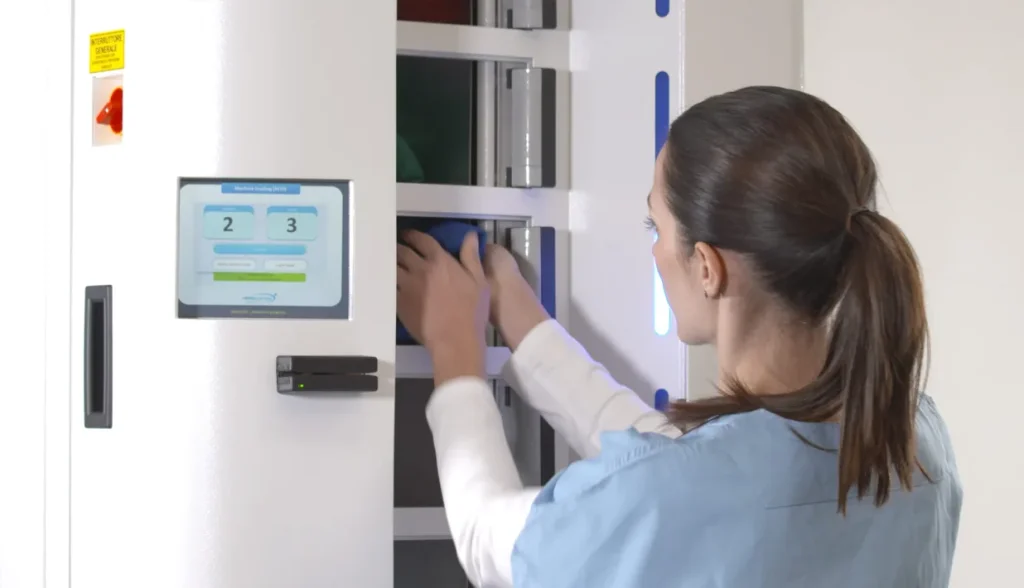
A Real-World Example of RFID Scrub Dispensing
The system used a modular dispensing design that could be configured to meet the facility’s operational requirements. RFID tracking helped improve garment accountability and visibility into uniform availability, while automated dispensing made it easier for healthcare staff to obtain clean apparel.
The application demonstrates how RFID can support a more organized process for distributing and collecting medical scrubs. Rather than relying entirely on manual records, healthcare facilities can use transaction data to better understand garment movement and identify potential inventory issues.
How an RFID Scrub Management System Works
An effective solution requires more than RFID tags alone. Hardware and software must work together to record garment movements and turn those records into useful inventory information.
1. RFID Tags Identify Individual Garments
Each tagged scrub can be associated with a unique identifier, allowing the system to distinguish one garment from another. Textile RFID tags must also withstand the washing, drying, and handling conditions expected throughout their service life.
2. Automated Dispensers Record Distribution
When authorized staff collect clean scrubs, the dispensing equipment records the transaction. Depending on the system configuration, access can be controlled through user permissions or predefined usage limits.
This creates a record of garment distribution without requiring staff to manually document every item.
3. RFID Collection Units Record Returns
When used scrubs are deposited into a compatible RFID-enabled collection unit, the system records their return. This helps linen teams understand how many garments have re-entered the collection process and are awaiting further handling.
4. Software Provides Inventory Visibility
The software combines transaction records with inventory information to help teams monitor usage, identify potential shortages, and plan restocking.
For example, if a department consistently uses more scrubs than expected, usage reports can help linen managers adjust replenishment levels. If garments are not returned as expected, transaction records can support further investigation.

Business Benefits Beyond Garment Tracking
A well-designed RFID scrub management system can support several operational improvements for healthcare facilities, from inventory control and automated recordkeeping to access management and more accurate replenishment planning.
- Better inventory control: Tracking distribution and returns helps reduce uncertainty about garment locations and whether enough clean scrubs are available.
- Less manual administration: Automated transaction records reduce repetitive manual logging and inventory checks.
- Controlled access: User permissions and dispensing limits can help facilities manage uniform distribution according to their operational policies.
- More informed restocking: Usage reports and inventory updates help linen teams make replenishment decisions based on actual demand.
- Improved operational visibility: Connecting dispensing, collection, and inventory records gives managers a clearer picture of garment circulation.
These benefits depend on appropriate RFID tag selection, equipment configuration, and integration with existing linen management processes. RFID improves visibility, but it does not replace the cleaning, handling, and infection-control procedures required in healthcare environments.
Building an Integrated RFID Textile Tracking Solution
The key to effective scrub management is not simply installing an RFID dispenser. It is connecting the entire tracking process, from garment identification to distribution, return, and inventory management.
For healthcare facilities planning a similar project, the system design should consider:
- Textile RFID tags suitable for repeated washing and long-term use;
- RFID readers and antennas configured for reliable identification;
- Dispensing and collection equipment suited to the facility’s workflow and space;
- Inventory management software for recording transactions and monitoring garment circulation;
- System integration to connect RFID data with existing operational processes where required.
At rfidsolution.com, we provide customized RFID hardware and software solutions for asset tracking and operational management. Depending on your project requirements, we can help evaluate suitable RFID components and system integration options for tracking uniforms, reusable textiles, and other managed assets.
Whether you are planning a new RFID deployment or upgrading an existing tracking process, the right combination of hardware and software can help improve asset visibility and establish a more reliable management workflow.
Whether you are planning a new RFID deployment or upgrading an existing tracking process, the right combination of hardware and software can help improve asset visibility and establish a more reliable management workflow.
Conclusion
An RFID scrub management system helps healthcare facilities move beyond manual uniform distribution toward more accountable, data-driven garment management. By combining RFID identification, automated dispensing and collection equipment, and inventory software, hospitals can gain better visibility into garment usage, returns, and stock levels.
The broader lesson is that effective RFID tracking depends on more than individual devices. By connecting hardware and software around the actual workflow, healthcare facilities can build a more reliable approach to managing medical uniforms and other reusable textiles.
Contact rfidsolution.com to discuss your RFID tracking requirements and explore a customized solution for your application.



 EN
 JA
 ZH