

Retailers are investing in RFID readers, POS systems, self-checkout solutions, electronic article surveillance (EAS), sensors, and inventory management software. However, adding more technology does not always lead to better results. When these systems operate independently, retailers may still struggle with inaccurate inventory data, inefficient checkout processes, and limited visibility across store operations.
For retailers planning a new RFID project or upgrading an existing system, integration should be considered from the beginning.
Why Retailers Need Better RFID System Integration
Modern retail environments often contain equipment and software from different vendors. RFID readers collect item-level data, POS systems process transactions, self-checkout platforms manage purchases, and loss prevention systems monitor potential theft.
Problems arise when these systems cannot exchange data efficiently.
For example, an RFID system may identify products on the sales floor, but if its data is not synchronized with the inventory management platform, employees may still rely on outdated stock information. Similarly, RFID-based item detection at checkout becomes less effective when product data cannot be matched reliably with transaction records.
Without proper RFID Retail System Integration, retailers may experience:
- Inconsistent inventory data across platforms
- Longer implementation and troubleshooting cycles
- Higher maintenance and integration costs
- Limited visibility into checkout and loss prevention activities
- Delayed responses to inventory discrepancies
These challenges are not necessarily caused by poor hardware. In many cases, the underlying issue is how devices, software, and business processes communicate with one another.

How RFID Retail System Integration Works
An effective RFID retail solution connects data collection at the device level with software applications that support daily operations.
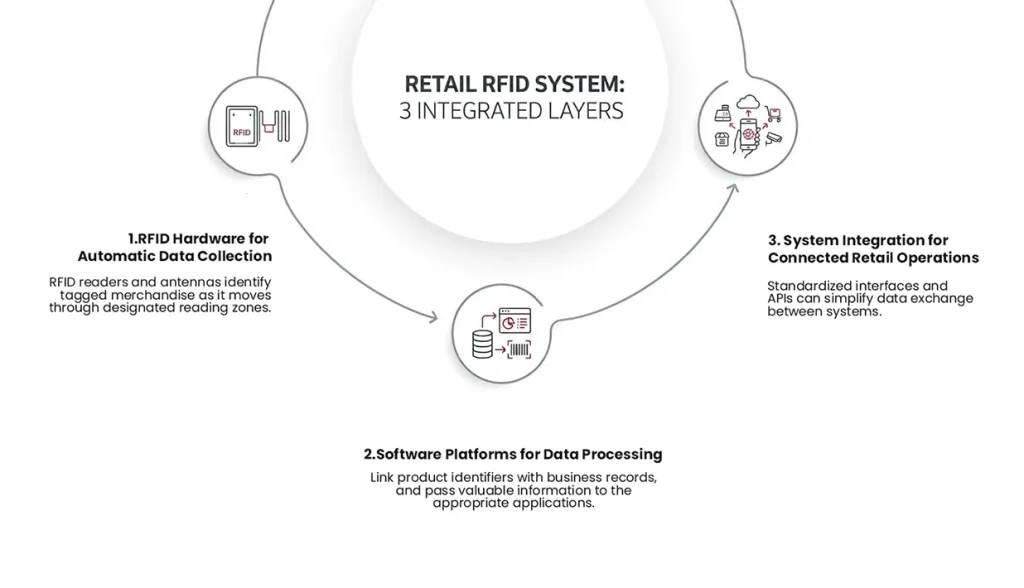
A well-designed RFID Retail System Integration solution typically includes three layers: RFID hardware, data processing software, and business system integration.
1. RFID Hardware for Automatic Data Collection
RFID readers and antennas identify tagged merchandise as it moves through designated reading zones. Depending on the application, hardware may be installed at store entrances, checkout areas, stockrooms, or other operational checkpoints.
Hardware selection depends on factors such as reading distance, tag orientation, product materials, installation space, and the number of items that need to be identified.
For example, a retailer implementing RFID at self-checkout needs to consider how readers detect tagged products and how that information is associated with the customer’s transaction.
Choosing suitable RFID hardware and configuring it for the actual store environment are essential to reliable data collection.
2. Software Platforms for Data Processing
RFID readers generate identification events, but raw tag reads alone do not provide a complete picture of retail operations.
Software must process the collected data, filter irrelevant reads, associate product identifiers with business records, and deliver meaningful information to the appropriate applications.
Depending on the project, the software layer may support:
- Inventory visibility and stock reconciliation
- Product movement tracking
- Checkout event processing
- Exception alerts and reporting
- Data exchange with inventory management or enterprise systems
This is where hardware integration becomes operationally valuable. Instead of treating each reader as an isolated device, retailers can use RFID data to support broader business workflows.
3. System Integration for Connected Retail Operations
The final layer connects RFID data with existing retail infrastructure, such as POS systems, self-checkout platforms, inventory management software, and loss prevention applications.
Standardized interfaces and APIs can simplify data exchange between systems. However, the exact integration approach depends on the protocols, data models, and interfaces supported by the existing equipment and software.
A well-designed RFID Retail System Integration architecture reduces unnecessary integration work and helps retailers expand their deployments without rebuilding the entire system whenever a new application is introduced.
From RFID Data to Real-Time Retail Decisions
When RFID hardware and software work together, retailers can move beyond basic item identification and support more responsive store operations.
- Inventory management: RFID reads can help reconcile recorded inventory with detected merchandise, making discrepancies easier to investigate and stock information more reliable.
- Checkout efficiency: In suitable RFID-enabled checkout environments, item identification data can support automated purchase verification and reduce the need for manual scanning. Actual results depend on reader configuration, product tagging, and POS integration.
- Loss prevention: When RFID item data is connected with transaction records and compatible security systems, retailers can identify discrepancies that require further investigation.
- Operational responsiveness: With edge computing, selected data processing and decision-making can take place close to the RFID device. This can reduce dependence on continuous communication with centralized servers and support faster local responses when network connectivity is limited.
With RFID Retail System Integration, retailers can connect item-level data with existing business systems, helping teams respond to inventory discrepancies faster and make more informed operational decisions.
These applications require more than installing readers. They depend on coordinated hardware configuration, software logic, and integration with existing business processes.
Why Integration Should Come Before Adding More Devices
When retailers encounter operational problems, adding more readers or other devices may seem like the easiest solution. However, additional hardware can introduce more interfaces to configure, maintain, and troubleshoot.
Before expanding a deployment, retailers should evaluate whether the current system can collect the necessary data, process it correctly, and deliver it to the applications that need it.
A practical integration plan should address four questions:
- What needs to be tracked? Define the products, movement events, and operational activities that require visibility.
- Where should RFID data be collected? Identify the reading zones and choose hardware suited to the physical environment.
- Which systems need the data? Map the required connections to POS, inventory management, self-checkout, or other applications.
- How will the solution scale? Consider future store rollouts, additional devices, software updates, and ongoing system maintenance.
Addressing these questions early can reduce unnecessary complexity and help ensure that the RFID investment supports measurable business objectives.

Conclusion
A successful retail RFID deployment requires the right combination of hardware, software, and system integration. Choosing a reader or tag is only one part of the process; the complete solution must fit the retailer’s products, store environment, and operational requirements.
At rfidsolution.com, we provide customized RFID hardware and software solutions designed around specific business applications. Depending on your project requirements, a solution can combine RFID readers, tags, data collection processes, and software integration to support inventory visibility, item tracking, and connected retail operations.
Whether you are planning a new RFID deployment or improving an existing system, evaluating the complete solution architecture can help identify integration requirements before they become costly implementation problems.
Our approach to RFID Retail System Integration focuses on connecting the right devices, data, and software workflows to support your operational goals.
Contact rfidsolution.com to discuss your RFID project requirements and explore a customized hardware and software solution for your retail operations.

INVENTRACK™ RFID Inventory & Warehouse Management Demo
Valid for 365 days, 30-day money-back guarantee.



 EN
 JA
 ZH