
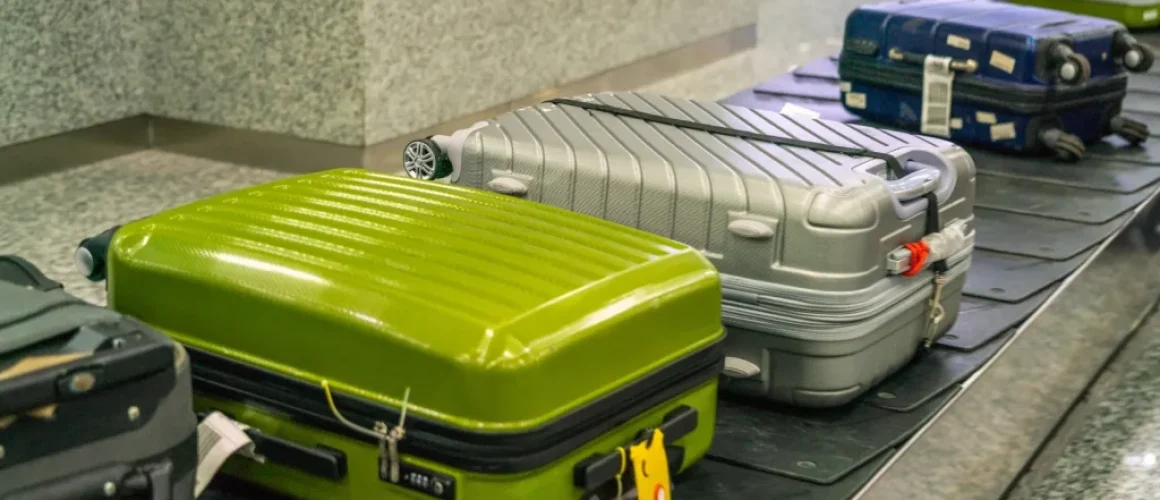
RFID baggage tracking is most useful at the exact places where airport baggage records usually go weak: sorting belts, transfer carts, loading zones, and arrival checks.
A bag normally disappears from the record before it disappears from the airport. It may still be sitting in a cart, waiting near a make-up area, or moving on the wrong conveyor. The problem is that the system no longer has a clean event showing where it was last confirmed.
That is where RFID changes the baggage process. A UHF RFID baggage label gives each checked bag an electronic identity that can be read without direct line of sight. The barcode can still stay on the tag for manual checks, but RFID gives the airport another way to capture movement when speed, angle, folding, dirt, or poor visibility make barcode reading unreliable.
For airports and airlines, the value is simple: fewer missed reads, better handover records, and faster exception handling when a bag does not follow the normal route.
Why Bags Get Lost in the System
Most mishandled baggage cases are not caused by one dramatic failure. They come from small breaks in the chain.
A label is folded around a handle. A barcode faces down on the conveyor. A transfer bag reaches the next flight late. A cart is moved before all bags are verified. A bag is pulled aside for manual handling and then re-enters the flow without a clear record.
In a busy terminal, these small gaps add up.
| Weak Point | What Can Go Wrong |
| Check-in | Bag accepted, but the first handling record is incomplete |
| Sorting | Bag moves through the system with a missed or weak scan |
| Transfer | Short connection time increases routing mistakes |
| Loading | Bag is staged near the aircraft but not properly verified |
| Arrival | Bag reaches the airport, but the record does not update in time |
| Exception handling | Staff know a bag is missing from the flow, but not where to start looking |
RFID baggage tracking does not replace good baggage handling discipline. It gives teams more reliable proof at the points where manual or barcode-only processes often lose visibility.
What Is RFID Baggage Tracking?
RFID baggage tracking uses RFID baggage tags or RFID baggage labels to identify checked luggage automatically. Each RFID label contains a chip and antenna with a unique code. That code can be linked to the bag record, flight, destination, transfer status, and handling events.
Most airport baggage applications use UHF RFID because it supports fast reading and can identify multiple bags moving through a read point. This makes it useful for conveyor belts, baggage carts, loading areas, and transfer zones.
A practical RFID baggage label usually includes both RFID and printed information:
- RFID inlay for automatic reading
- barcode for manual backup
- human-readable flight or bag data
- printable surface for airport baggage systems
- adhesive structure suitable for short-term baggage handling
This matters because airport operations still need fallback options. RFID improves automated capture, but staff may still need barcode or printed data when handling exceptions.

RFID Baggage Tags vs Barcode Tags
Barcode baggage tags have worked for years, but they depend on visibility. RFID baggage tags are more forgiving in real baggage environments.
| Factor | Barcode Baggage Tag | RFID Baggage Tag |
| Reading | Needs visible barcode | Reads without direct line of sight |
| Bag angle | Sensitive to position | More tolerant of position |
| Speed | Often one bag at a time | Suitable for fast checkpoints |
| Damage | Folded or scratched print may fail | RFID can still read if print is less visible |
| Best role | Manual scan and backup | Automated baggage verification |
The best setup is often not “RFID instead of barcode.” It is an RFID baggage label with printed barcode, so both automated and manual workflows remain available.
Where RFID Readers Should Be Used
RFID readers should not be placed only where installation is easy. They should be placed where a baggage event has operational value.
| Read Point | Why It Matters |
| Check-in | Confirms the bag has entered the baggage handling system |
| Sortation | Checks whether the bag is moving toward the correct flight or zone |
| Make-up area | Verifies bags prepared for loading |
| Aircraft loading | Confirms bags assigned to the right aircraft |
| Transfer area | Tracks bags moving between flights |
| Arrival handling | Confirms the bag reached the destination airport |
| Exception zone | Speeds up manual review and recovery |
A read is only useful if the system knows what the read means. Before deployment, airports should define event rules clearly: accepted, sorted, staged, loaded, transferred, arrived, or exception.
Without those rules, RFID data can become another stream of noise.
Real Case: Delta Air Lines and RFID Bag Tracking
Delta Air Lines is one of the clearest public examples of large-scale RFID baggage tracking. The airline reported a major RFID rollout across its global airport network, with RFID bag tags read by scanners at different points of the journey and baggage status updates delivered to passengers through the Fly Delta app. Delta also reported a 99.9% tracking success rate for RFID-tracked bags and a $50 million investment to support rollout across 344 airports worldwide.
The important part is that Delta’s project was not only about putting RFID inside a baggage tag. Public reporting described a wider handling setup: RFID bag tag printers, handheld RFID readers, pier and claim readers, and belt-loader reading points. These reading points help verify bags during actual handling, including when bags are being loaded onto or removed from an aircraft.
For airports and airlines, this is the practical lesson. RFID baggage tracking works best when the label, printer, reader location, software event, and exception process are designed together. The label identifies the bag. The read point confirms the handling event. The system decides whether that event is normal or needs attention.
That is also why small pilots should not test RFID labels only on a desk. The real test is whether the label can be read on actual bags, at conveyor speed, in loading areas, and at the points where baggage ownership or routing changes.

What Makes a Good RFID Baggage Label?
A baggage label has a short life, but it has a hard job. It must go through printing, folding, passenger handling, conveyor movement, cart loading, aircraft handling, and arrival processing.
A suitable RFID baggage label should be tested for:
- stable UHF RFID performance
- readable placement on real baggage
- printing quality for barcode and text
- adhesive strength during handling
- reliable reading on moving conveyors
- encoding consistency
- compatibility with airport readers and baggage software
Static desk testing is not enough. A label that reads well on a table may perform differently on a moving belt, attached to a soft bag, wrapped around a handle, or placed near other luggage.
Common Buying and Deployment Mistakes
Many baggage RFID problems start before installation.
| Mistake | Result |
| Buying labels only by price | Poor read stability under airport conditions |
| Testing clean, stationary bags only | Missed reads appear during real operation |
| Ignoring tag placement | Some bag types read better than others |
| No duplicate-read filtering | One bag creates too many events |
| No exception workflow | Staff still search manually when bags leave the normal path |
| No integration plan | RFID reads do not become useful baggage events |
For airports, airlines, and baggage system integrators, the test should include real luggage, real conveyor speed, real reader positions, and real event logic.

Summary
RFID baggage tracking is most valuable when airports and airlines need stronger records at the points where baggage visibility often breaks: sorting, transfer, loading, arrival, and exception handling.
The project should not start with labels alone. It should start with the baggage flow: where bags are accepted, where they change ownership, where they are loaded, and where staff need proof.
With the right RFID baggage labels, UHF readers, and event rules, airports can reduce missed scans, improve transfer visibility, and handle exceptions faster.
If your airport, airline, or baggage handling project needs RFID baggage labels, UHF readers, or real-world tag testing for conveyor and transfer environments, visit rfidsolution.com to explore RFID baggage tracking solutions for airport operations.
FAQ
1. What is RFID baggage tracking?
RFID baggage tracking uses RFID baggage tags or labels to identify checked luggage as it moves through airport handling points such as check-in, sorting, transfer, loading, and arrival.
2. Are RFID baggage tags better than barcode tags?
RFID baggage tags are better for automated reading because they do not require direct line of sight. Barcode is still useful as a backup, so many baggage labels use both RFID and printed barcode.
3. Where should RFID readers be installed?
Common read points include check-in, sortation, make-up areas, loading zones, transfer points, arrival handling, and exception areas.
Recommended Product

TrakOn® Overhead UHF RFID Reader with Sound and Light Alert – ISO/IEC 18000-6B/C – 865-868MHz or 902-928MHz
This top-mounted UHF RFID access gate is designed for automated asset identification and movement monitoring across enterprise and industrial environments. With long-range multi-tag reading capability and flexible integration options, it helps improve tracking efficiency and reduce manual operations. Frequency: UHF 865-868 MHz, UHF 902-928 MHz, Adjustable upon request Protocol:ISO/IEC 18000-6B/C, EPCglobal Class 1 Gen […]



 EN
EN  JA
JA  ZH
ZH