
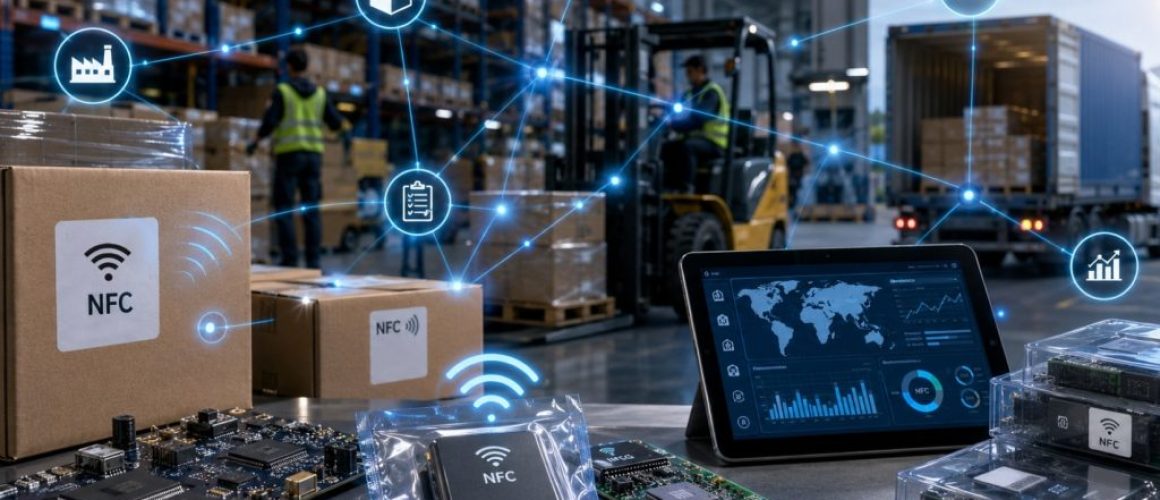
Electronic supply chain management is becoming increasingly difficult to control. As products move through multiple suppliers and production stages, ensuring component authenticity and maintaining full visibility across the supply chain has become a major challenge for manufacturers.
Counterfeit risks and traceability gaps are no longer rare issues—they are now core concerns for electronics brands operating in global markets.
So the key question is: How can manufacturers improve supply chain visibility while ensuring every component can be trusted?
This article explores how NFC technology is being used to enhance traceability and visibility in electronic supply chain management.
Why Traditional Tracking Systems Fall Short
While many electronic manufacturers already use digital tools such as barcodes, QR codes, and ERP systems to manage supply chain data, these solutions were not designed to ensure product authenticity or real-time verification.
Barcodes and QR codes can be easily copied or reused, which makes them unreliable for high-value electronic components where security is critical. They can identify an item, but they cannot prove whether that item is genuine.
ERP systems, on the other hand, are useful for managing data and workflows, but they operate primarily as record-keeping platforms. They lack the ability to validate physical components at the point of interaction, meaning discrepancies in the supply chain often go undetected until much later.
As a result, companies may have structured supply chain data, but still lack true security and trust at the product level—especially when components move across multiple suppliers and regions.

What traceability means in the electronics industry
In the electronics industry, traceability refers to the ability to identify and track each component throughout its entire lifecycle—from raw material sourcing and manufacturing to assembly, distribution, and final delivery.
A complete electronic traceability system allows manufacturers to know exactly where a component comes from, how it has been processed, and where it has been used. This level of visibility is essential for maintaining quality control and compliance in complex production environments.
Why it is critical for high-value components
For high-value or sensitive electronic components, traceability is not optional—it is essential.
Components such as semiconductors, PCB assemblies, and integrated circuits are often used in critical applications where even a small defect or unauthorized modification can lead to system failure. Without proper traceability, manufacturers face significant risks including quality issues, regulatory non-compliance, and counterfeit infiltration.
Traceability helps ensure that every component in the supply chain can be verified, reducing uncertainty and strengthening overall product integrity.
Connection between traceability and supply chain security
Traceability plays a direct role in strengthening supply chain security. When every component has a clear and verifiable history, it becomes significantly harder for counterfeit or unauthorized products to enter the system unnoticed.
In other words, supply chain security is only as strong as its traceability framework. Without reliable tracking and verification mechanisms, even well-structured supply chains remain vulnerable to hidden risks.
How NFC Improves Supply Chain Traceability and Visibility
NFC (Near Field Communication) is a short-range wireless technology that enables secure data exchange and identification between devices or tags when they are brought into close proximity.
In electronic manufacturing, NFC technology is increasingly being adopted as a more secure and reliable way to improve supply chain traceability and visibility.
Unique Product Identity
Each product or electronic component can be embedded with an encrypted NFC tag that carries a unique digital identity.
This identity cannot be easily copied or modified, which ensures that every item in the supply chain can be distinguished at the individual level rather than only at batch or packaging level. As a result, manufacturers gain a higher level of control and accuracy in tracking product movement and origin.
Real-Time Authentication
One of the key advantages of an NFC authentication system is the ability to perform instant verification.
By simply scanning the NFC tag using a mobile device or reader, manufacturers, distributors, or inspectors can immediately confirm whether a product is genuine. This real-time authentication capability significantly reduces the risk of counterfeit or unauthorized components entering the supply chain undetected.
End-to-End Traceability
Beyond authentication, NFC enables full lifecycle traceability across the entire supply chain.
From manufacturing and assembly to logistics and final distribution, every scan or interaction with the NFC tag can be recorded and linked to a digital system. This creates a continuous data trail that supports a complete product traceability system, improving visibility, accountability, and supply chain control.

Applications of NFC in the Electronics Industry
NFC-based traceability and authentication solutions are being widely applied across different segments of the electronics industry, particularly in environments where precision, authenticity, and control are critical.
Semiconductor Manufacturing Tracking
In semiconductor production, even minor deviations or unauthorized substitutions can lead to significant performance issues. NFC tags can be used to identify and track wafers, chips, and related materials throughout the production process, helping manufacturers maintain consistent tracking across multiple fabrication stages.
PCB Lifecycle Management
Printed circuit boards (PCBs) often pass through several assembly, testing, and integration stages before becoming part of a final product. NFC technology enables each PCB to carry a unique identifier, allowing manufacturers to monitor its lifecycle from production to final assembly and ensure proper process documentation at every step.
High-Value Component Authentication
For high-value electronic components, such as advanced ICs or specialized modules, NFC-based authentication provides a way to verify product legitimacy at any point in the supply chain. This helps reduce the risk of unauthorized replacement or tampering during storage, transit, or installation.
Brand Protection in Global Distribution
In global distribution networks, electronic products often pass through multiple intermediaries before reaching the end customer. NFC-enabled identification helps brands maintain control over product authenticity across different regions and distribution channels, supporting stronger brand protection and reducing the risk of counterfeit infiltration.
Consumer Electronics Product Authentication
Consumer electronics such as smartphones, wearable devices, and smart home products are increasingly exposed to counterfeiting and unauthorized replication risks. Product-level authentication has therefore become essential for ensuring authenticity from production to end-user delivery.
NFC-based identification allows each finished device to carry a unique, verifiable identity, enabling brands to validate products at any point in the distribution chain and reduce the risk of counterfeit units entering the market.
Business Benefits of NFC in Supply Chain Management
Implementing NFC technology in electronic supply chain management delivers significant business value by improving operational transparency, reducing risks, and enhancing overall efficiency across the entire product lifecycle.
Improved supply chain visibility
NFC enables real-time tracking and verification of individual components throughout the supply chain. Each scan creates a digital interaction point, allowing manufacturers and stakeholders to gain a clearer, more accurate view of product movement and status.
This improved visibility helps reduce information gaps between different supply chain stages and supports more informed decision-making.
Reduced counterfeit risks
One of the most important benefits of NFC-based systems is the ability to significantly reduce counterfeit and unauthorized products entering the supply chain.
Because each NFC tag carries a unique and encrypted identity, it becomes extremely difficult to replicate or replace components without detection. This strengthens product integrity and helps protect brands from financial and reputational damage.
Faster verification process
NFC technology allows instant product authentication through a simple scan using a mobile device or reader. This eliminates the need for manual checks or complex verification procedures, significantly speeding up inspection and validation processes across manufacturing and distribution environments.
Better inventory control
With NFC-enabled tracking, manufacturers can gain more accurate and real-time insights into inventory levels and product movement. This reduces errors in stock management, minimizes losses caused by misplacement, and improves overall operational efficiency in supply chain operations.

Conclusion
As electronic supply chains continue to expand globally, the need for greater transparency, security, and real-time visibility is becoming increasingly important for manufacturers and brand owners.
NFC technology offers a practical way to achieve this by enabling secure, unique product identification and verifiable tracking throughout the entire supply chain. This helps manufacturers strengthen control over product authenticity while improving overall supply chain visibility.
If your business is looking to improve supply chain visibility and prevent counterfeit risks, NFC-based authentication can provide a scalable and secure solution for electronic products.
Contact us to discuss your supply chain authentication needs.
FAQs
1. How much does an NFC-based traceability system cost for electronics supply chains?
The cost of an NFC-based traceability system depends on factors such as production volume, tag type, level of encryption, and system integration requirements. In most cases, pricing is structured based on per-tag cost and backend system setup, making it scalable for both small and large manufacturers. If you need a tailored quotation, you can request it here.
2. Is NFC traceability suitable for existing electronic manufacturing systems?
Yes. NFC-based traceability solutions can be integrated into most existing manufacturing and ERP systems without requiring a complete infrastructure change. They are typically added as an additional authentication layer to enhance, not replace, current supply chain systems.
3. How secure is NFC technology for supply chain authentication?
NFC technology is highly secure when using encrypted or cryptographic chips. Unlike simple QR codes or barcodes, NFC tags can include authentication protocols that prevent duplication and unauthorized cloning, making them suitable for high-value electronic components.
4. Can NFC tags survive harsh manufacturing and logistics environments?
Yes. Industrial-grade NFC tags are designed to withstand heat, pressure, moisture, and chemical exposure, making them suitable for electronics manufacturing, assembly lines, and global logistics environments.
5. What is the difference between NFC traceability and RFID tracking in electronics?
NFC is typically used for item-level authentication and secure verification at close range, while RFID is more commonly used for bulk tracking and inventory management. In electronics supply chains, NFC is often preferred when product-level identity verification and anti-counterfeit protection are required.



 EN
EN  JA
JA  ZH
ZH