

Manual inventory counting in warehouses is a labor-intensive and error-prone process that often leads to significant operational inefficiencies and financial losses. Businesses frequently grapple with inaccurate stock levels, delayed order fulfillment, and the substantial costs associated with periodic stocktakes that disrupt normal operations. These challenges underscore a critical need for more efficient and accurate inventory management. This article explores how warehouse RFID solutions offer a transformative approach, automating inventory visibility and eliminating the need for manual counting.
1. The Hidden Costs of Manual Inventory Counting in Warehouses
At first glance, manual counting seems simple: assign staff, count items, reconcile numbers. In practice, the true costs are much higher.

1.1 Labor-intensive counting process
Manual counting requires significant human effort, often involving teams of workers dedicating hours, if not days, to physically count and record inventory. This diverts valuable labor resources from more productive tasks such. The sheer scale of inventory in modern warehouses makes this process incredibly time-consuming and expensive.
1.2 Human errors and inventory discrepancies
Despite best efforts, human error is an inevitable part of manual processes. Miscounts, data entry mistakes, and misplaced items lead to inventory discrepancies. These inaccuracies can cascade through the supply chain, affecting everything from purchasing decisions to customer satisfaction.
1.3 Operational downtime during stocktaking
Many warehouses must halt or significantly slow down operations during full inventory counts to ensure accuracy. This operational downtime translates directly into lost productivity and revenue. The disruption can be particularly damaging for businesses operating on tight schedules or with high-volume throughput.
1.4 Inaccurate data affecting order fulfillment
When inventory records are inaccurate, businesses risk promising products they don’t have or failing to locate items that are in stock. This leads to delayed or incorrect order fulfillment, resulting in customer dissatisfaction, increased return rates, and potential loss of future business.
1.5 Lack of real-time visibility
Manual counting provides only a snapshot of inventory at a specific moment. It lacks the ability to offer real-time insights into stock levels, movement, or location. This absence of dynamic visibility hinders proactive decision-making and responsiveness to changes in demand or supply.
2. What Are Warehouse RFID Solutions?
Warehouse RFID solutions encompass a system of hardware and software components that work in concert to automate the identification and tracking of inventory items within a warehouse environment. The primary goal is to eliminate manual counting and provide continuous, accurate inventory data.
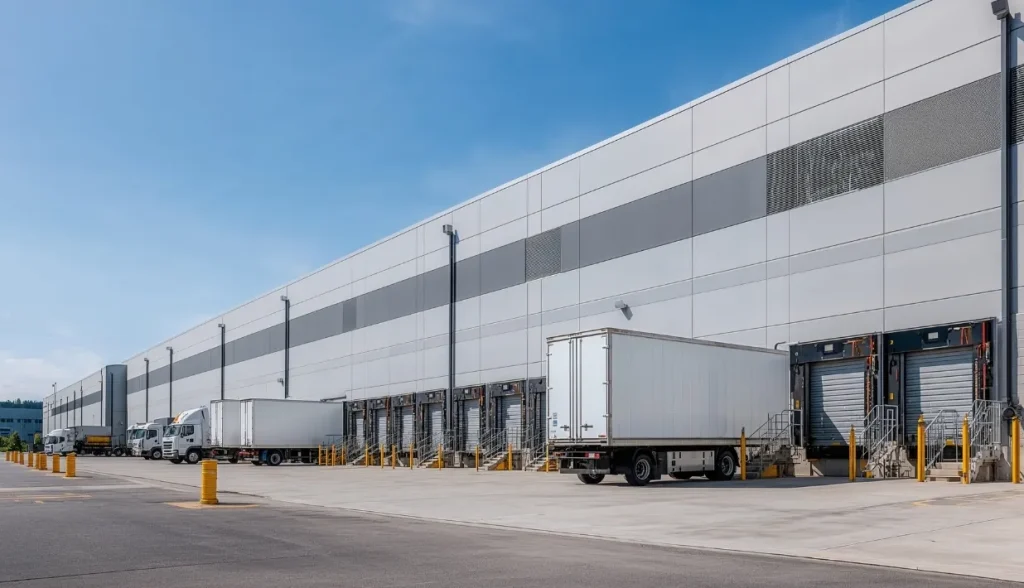
A complete solution includes:
- RFID tags attached to pallets, cartons, or individual items
- Fixed and handheld RFID readers
- Proper antenna placement at dock doors, conveyors, and aisles
- Middleware to filter and structure read events
- Integration with a Warehouse Management System (WMS)
Unlike barcodes, RFID does not require line-of-sight or manual scanning. Multiple tagged items can be read simultaneously, even when they are inside cartons, stacked on pallets, or moving through dock doors.
3. How RFID Replaces Manual Counting: Step-by-Step Workflow
The implementation of RFID technology fundamentally alters the inventory management workflow, moving away from manual, labor-intensive processes towards automated, efficient data capture. Here’s a step-by-step breakdown of how RFID eliminates manual counting.
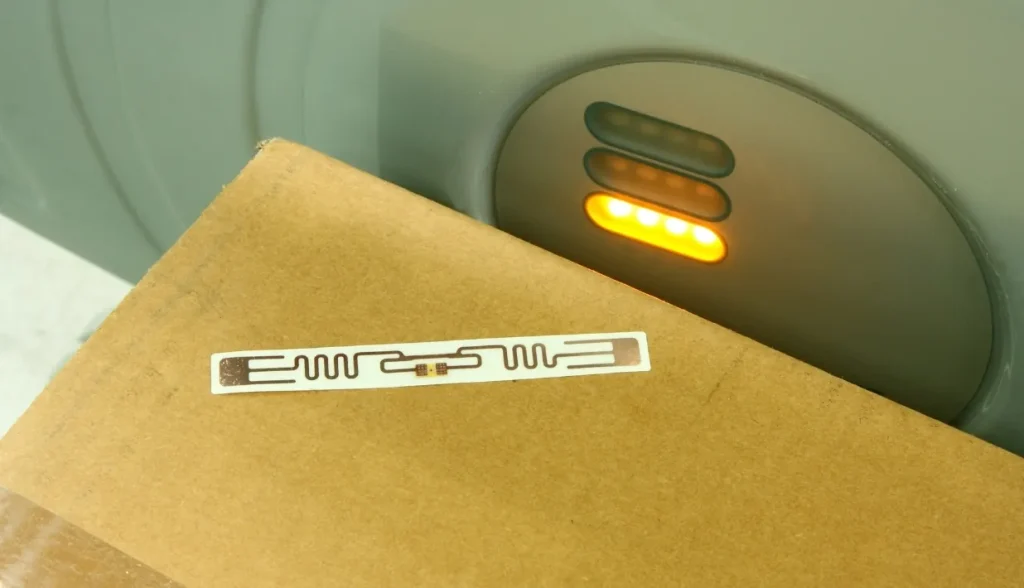
Step 1 – Tagging Inventory with RFID Tags
The first critical step is to apply RFID tags to inventory items. This can occur at various levels:
- Pallet-level tagging: A single RFID tag is affixed to an entire pallet, representing all the goods contained within. This is efficient for bulk movements.
- Carton-level tagging: Each carton or case receives an RFID tag, allowing for more granular tracking than pallet-level, but less than item-level.
- Item-level tagging: Every individual product unit is tagged. This provides the highest level of visibility and accuracy, crucial for high-value items or detailed inventory control.
Specialized tags, such as on-metal tags, are used for items or shelves made of metallic materials, which can interfere with RFID signals, ensuring reliable performance across diverse warehouse environments.
Step 2 – Automatic Data Capture with RFID Readers
RFID readers capture tag data automatically at critical points:
- Dock doors during receiving and shipping
- Conveyor lines during movement
- Storage aisles during cycle counts using handheld readers
- RFID gates for controlled entry/exit
No one needs to stop and scan. Data is captured as part of the natural workflow.
Step 3 – Real-Time Data Sync with WMS
The data captured by RFID readers is immediately transmitted to the Warehouse Management System (WMS). This real-time synchronization is a cornerstone of effective warehouse RFID solutions:
- Readers send data directly to WMS: As soon as an RFID tag is read, the information (e.g., item ID, location, timestamp) is sent to the WMS. This eliminates manual data entry and the delays associated with it.
- Inventory updates automatically without human input: The WMS processes this incoming data, automatically updating inventory records. Stock levels, locations, and movement histories are refreshed in real-time, providing an always-current view of inventory.
- Continuous inventory accuracy: This automated, continuous data flow ensures a high level of inventory accuracy, significantly reducing discrepancies and the need for periodic, disruptive physical counts.
4. The Role of WMS in Warehouse RFID Solutions
The WMS acts as the central repository and processing engine for all inventory-related data. When RFID readers transmit tag information, the WMS performs several critical functions:
- Identification and validation: It identifies the item associated with the RFID tag and validates its presence against expected inventory levels or locations.
- Location assignment: It updates the item’s location within the warehouse layout, providing precise tracking.
- Status updates: It changes the status of items (e.g., received, put away, picked, shipped) based on their movement through RFID read zones.
- Order fulfillment integration: It links inventory to specific orders, ensuring that the right products are available for picking and shipping.
With WMS integration, businesses gain unparalleled visibility:
- Real-time stock levels: Managers can view exact quantities of every SKU in the warehouse at any given moment, eliminating guesswork and enabling accurate demand forecasting.
- Location tracking: The precise location of every tagged item is known, drastically reducing search times and preventing misplaced inventory.
- Movement history: A complete audit trail of an item’s journey through the warehouse, from receiving to shipping, is maintained, aiding in accountability and problem resolution.
5. Real-World Scenarios Where RFID Eliminates Counting
Here are several real-world scenarios where RFID significantly enhances efficiency and accuracy.

5.1 Inbound Receiving
As pallets pass through dock doors equipped with RFID portals, every tagged carton or item is read instantly. The WMS confirms receipt automatically—no manual counting, no barcode scanning.
5.2 Storage and Put-Away
When a forklift places a pallet into a rack location with RFID coverage, the system records the exact location automatically. Operators don’t need to scan locations or items.
5.3 Cycle Counting
Instead of touching items one by one, a worker walks down the aisle with a handheld RFID reader. Hundreds of tags are captured in seconds. What used to take hours now takes minutes.
5.4 Outbound Shipping Verification
As shipments pass through an RFID gate, the system verifies that the correct items are leaving. Shipping errors are detected before trucks depart.
6. Hardware Needed for Effective Warehouse RFID Solutions
The choice of hardware depends on the specific warehouse environment, the types of items being tracked, and the desired level of granularity and automation.

6.1 RFID tags for different materials and levels
- Passive UHF RFID tags: These are the most common type, cost-effective, and suitable for a wide range of applications.
- On-metal tags: Specifically designed to perform reliably on metallic surfaces, which can otherwise interfere with RFID signals
6.2 Fixed readers for gates and dock doors
Fixed RFID readers are strategically installed at choke points to create automated read zones. Key locations include:
- Receiving docks: To automatically capture incoming inventory.
- Shipping docks: To verify outgoing shipments.
- Conveyor belts: For tracking items during sorting and movement.
- Entry/exit points: To monitor inventory movement between different zones of the warehouse.
These readers continuously scan for RFID tags, providing real-time data to the WMS without human intervention.
6.3 Handheld readers for mobile verification
Handheld RFID readers offer flexibility and mobility, complementing fixed reader installations. They are indispensable for:
- Cycle counting: Rapidly scanning entire aisles or sections of inventory.
- Item location: Quickly finding misplaced items.
- Ad-hoc inventory checks: Performing on-demand audits or verifying specific stock levels.
- Exception handling: Investigating discrepancies flagged by the WMS.
Modern handheld readers are often ruggedized for warehouse environments and feature integrated barcode scanners for hybrid operations.
6.4 Antenna placement strategy
The effective placement of RFID antennas is crucial for optimizing read rates and ensuring comprehensive coverage. Factors to consider include:
- Read zone size and shape: Antennas need to be positioned to create an optimal read zone that covers the entire area where tags are expected to pass.
- Interference: Avoiding interference from metal objects, other RFID systems, or electronic devices.
- Directionality: Using directional antennas to focus the read field and prevent stray reads from adjacent areas.
- Height and angle: Adjusting antenna height and angle to ensure tags are read consistently, regardless of their orientation on items or pallets.
Proper antenna strategy ensures that all tagged items are accurately captured, maximizing the benefits of warehouse RFID solutions.
7. Benefits of Eliminating Manual Inventory Counting
Warehouses that replace manual counting with RFID typically achieve:
- Inventory accuracy above 99%
- Major reduction in labor hours spent on counts
- No operational downtime for stocktakes
- Real-time visibility for planners and managers
- Fewer picking and shipping errors
- Reduced shrinkage and misplaced goods
Most importantly, inventory becomes a continuously verified dataset rather than a periodically corrected estimate.
8. Conclusion
Today, warehouse RFID solutions allow inventory to be tracked automatically as part of daily operations. With the right combination of RFID tags, readers, antenna design, and WMS integration, warehouses can eliminate counting tasks, improve accuracy, and gain real-time control over inventory.
RFIDSolution provides reliable warehouse management systems, RFID tags, and RFID readers for warehouse operations. Feel free to contact us or visit our website to explore the right RFID solution for your business.




 EN
EN  JA
JA  ZH
ZH